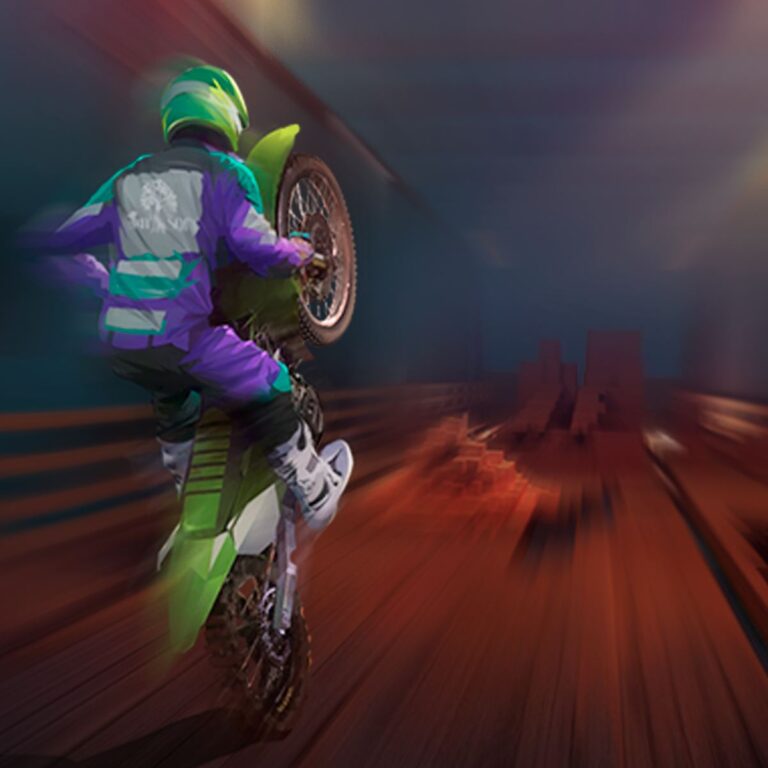
Moto Maniac 2 challenges riders on night-time construction bridges. Read guidance for using the drone light and keeping balance.
Moto Maniac 2 changes the challenge with darkness
Moto Maniac 2 is a trial bike game set around bridges under construction at night. You ride over narrow, unfinished pathways while a drone helps illuminate the area ahead. The bike physics still matter, but reduced visibility makes planning the next movement more difficult.
The game is related to Moto X3M because it asks you to keep a motorcycle upright around challenging obstacles. It differs from stunt racing by focusing on narrow technical terrain and a more deliberate pace.
Look ahead with the drone
Use the light to understand where a platform ends and where the next safe section begins. A sudden acceleration when you cannot see the landing risks losing the bike before you have a chance to correct it.
Protect the balance of both wheels
Approach a raised surface slowly enough to lift the front wheel without flipping backward. Once the front wheel settles, bring the rear wheel over with a controlled burst of power. On a narrow bridge, avoid large changes in tilt unless there is a genuine obstacle to clear.
Getting through a difficult crossing
Take note of which wheel slips off the bridge. If it happens at the front, adjust your entry angle. If the rear wheel slides, reduce power as you crest the obstacle. One small change is easier to evaluate than several frantic corrections.
The observed Poki game document is staged here for owner testing. The player and keyboard inputs still require a successful real game test.
Moto Maniac 2 controls and its 20 new courses
Created by IriySoft, Moto Maniac 2 adds 20 new levels to the technical trial-bike formula. Poki confirms the same basic commands as its predecessor: Up or W to move forward, Down or S to move backward, and P to pause. Unlike a high-speed circuit race, the key skill is often releasing the throttle before the bike leaves a narrow surface. A successful crossing should place both wheels where the next obstacle is manageable.
The sequel’s darker construction setting makes it particularly important to read the route ahead. You need to consider not just the object under the front wheel, but where the rear wheel will land. A long gap or raised edge may be difficult because of the approach, not because you need more speed.
A reliable bridge-crossing sequence
- Look beyond the front wheel to identify the next safe surface.
- Advance just enough to place the front wheel onto the raised obstacle.
- Release pressure as the frame begins to climb so the rear wheel has time to settle.
- Move forward again only when the bike has a stable angle.
- After a crash, identify the first wheel that lost support and change that one phase.
This sequence replaces frantic button pressing with a clear progression. On a course that features several obstacles in a row, mastering the exit of one is just as important as surviving its entrance.
Diagnose the crash before restarting
| Crash pattern |
Next adjustment |
| Front wheel strikes a tall edge |
Reduce your approach speed and attempt a cleaner climb |
| Rear wheel slips off a bridge |
Ease off power once the bike reaches the top |
| Bike over-rotates after a small gap |
Enter with a steadier angle and less excess momentum |
Which bike game suits your mood?
For daylight obstacles and a slower learning curve, start with Moto Maniac. For faster, more theatrical tracks, visit Moto X3M. If you would rather race a rival across hills instead of solving solitary trials, try Mad Skills Motocross 2. See the official Poki description for the sequel’s level count and control reference.