Trial and Balance Bike Games
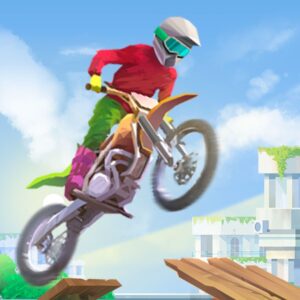
Trial and balance bike games feel different from fast motorcycle racing. The track is often short, but almost every object demands attention: a log that catches the front tyre, a crate that tips the frame or a narrow bridge that leaves almost no room to correct a mistake. This category focuses on Moto Maniac and Moto Maniac 2, two technical 2D motorcycle challenges from IriySoft where careful control matters more than holding the throttle as long as possible.
Start with the original, then tackle the sequel
Moto Maniac introduces the rhythm of crossing uneven objects while keeping a small dirt bike upright. You learn to press forward briefly, watch where the front wheel touches and avoid pushing the rear wheel too aggressively over a raised surface. Moto Maniac 2 expands the challenge with 20 new levels and a night-time construction atmosphere. It is a distinct sequel rather than a copy of the same course, and the darker environment makes route planning especially important.
Both games list Up Arrow or W for forward driving, Down Arrow or S for backward driving and P to pause. Do not assume the left and right tilt controls from Moto X3M are available here: use the actions documented for these trial games instead.
Choose the right response to an awkward surface
| Situation | Suggested action |
|---|---|
| Front wheel reaches a raised log | Use one short burst and observe the wheel climbing |
| Rear wheel starts to slip on a narrow bridge | Release power until the bike settles |
| The bike is stuck against a box | Consider a small backward correction before trying again |
| A gap follows immediately after the obstacle | Look ahead before accelerating off the edge |
How to build a repeatable crossing technique
Take a difficult section and divide it into three moments: entry, crossing and exit. During entry, decide how much speed is really needed to lift the front wheel. During the crossing, monitor where the rear wheel is going and stop pressing forward if the bike begins to tip. During exit, prepare the motorcycle for the very next surface rather than celebrating too early. A safe first obstacle is not enough if the next one immediately knocks the rider off the bike.
- Identify the first place where the wheel loses stable contact.
- Repeat the crossing using less continuous forward input.
- Use the reverse key only when it genuinely helps recover your position.
- Complete the next obstacle with the same deliberate rhythm.
- After succeeding, try a slightly faster attempt without abandoning your safe approach.
Why rushing can make a short level feel impossible
A timer may encourage speed, but failing at the same obstacle five times usually costs more time than a measured first attempt. If a log is difficult, pay attention to whether the front wheel hits too low or the rear wheel falls while crossing. Change just one input duration on your next attempt. This makes each run a useful experiment. Technical riding rewards consistency rather than dramatic but uncontrolled stunts.
Explore faster alternatives after learning balance
Once you are comfortable with small corrections, the original Moto X3M is a good place to practise airborne tilt and hazard timing. Stunt Bike Extreme adds wheelies and flips for experience points, while Bike Racing and Motocross introduces direct competition. The pages in this trial category remain independent guides with externally delivered players, so hands-on testing is necessary before claiming on-site controls work.